Stop Making Yourself Easy to Compare

Sr. Business Development Mgr.
i3screen
There is a lot of talk about commoditization in the screening industry, and it’s not difficult to understand why. Put several screening providers next to each other on paper and, at first glance, they can look remarkably similar.
The technology platforms have many of the same core capabilities. Consumer reporting agencies (CRAs) use many of the same data sources. Drug and alcohol testing providers and third-party administrators (TPAs) work with many of the same laboratories and clinic networks. Everyone has integrations. Everyone talks about service. Everyone promises fast turnaround times.
Those of us who have spent years in this industry know there can be enormous differences between providers. The problem is that the prospect may not know how to see them.
So they ask the questions they know how to ask: How much does it cost, and how fast can you do it?
Then we complain that everything has become about price and turnaround time. But maybe that’s not entirely the prospect’s fault. If we haven’t given them another way to differentiate us, what else should they compare?
Recognize What They’re Telling You
When a prospect asks about price or turnaround time early in a conversation, those aren’t bad questions. Both matter. But they’re also giving you a pretty clear signal: they may not know what else they should be asking.
That’s an opportunity to lead the conversation.
When someone asks me about pricing early in the process, my response is usually something along the lines of, “It’s hard for me to say right now until I understand your situation and needs a little better, but I’m confident our pricing is competitive. If you feel like we’re the right solution for you, I’m confident we’ll be able to figure out the pricing.”
That’s not a sales trick or a clever way to dodge the question. It’s fundamental to a consultative sale. I don’t know enough yet to tell you what the right solution looks like, so how can I possibly tell you exactly what it should cost?
Instead, I want to understand why you’re looking. What’s working well today and what isn’t? What takes too much of your team’s time? What are your customers asking for that you struggle to provide? What do you wish your current provider did differently? If we’re sitting here a year from now and you’re thrilled that you made a change, what changed?
Those questions help uncover needs, but they also give you an opportunity to educate. Maybe the prospect hadn’t thought about implementation, applicant experience, exception management, occupational health, integrations or what actually happens when something goes wrong.
A good salesperson doesn’t just answer the prospect’s questions. They help the prospect understand which questions they should be asking. You’ve stopped responding to their checklist and started helping create it.
But you need somewhere to take the conversation.
If your company really does look exactly like everyone else, the best salesperson in the world can only redirect the conversation for so long. Differentiation can’t simply be a sales responsibility. The business has to create something worth selling.
Telling your sales team to “sell value” without giving them meaningful value to sell isn’t a sales strategy.
Solve More of the Customer’s Problem
One of the best places to start is by looking at the problems surrounding the services you already provide.
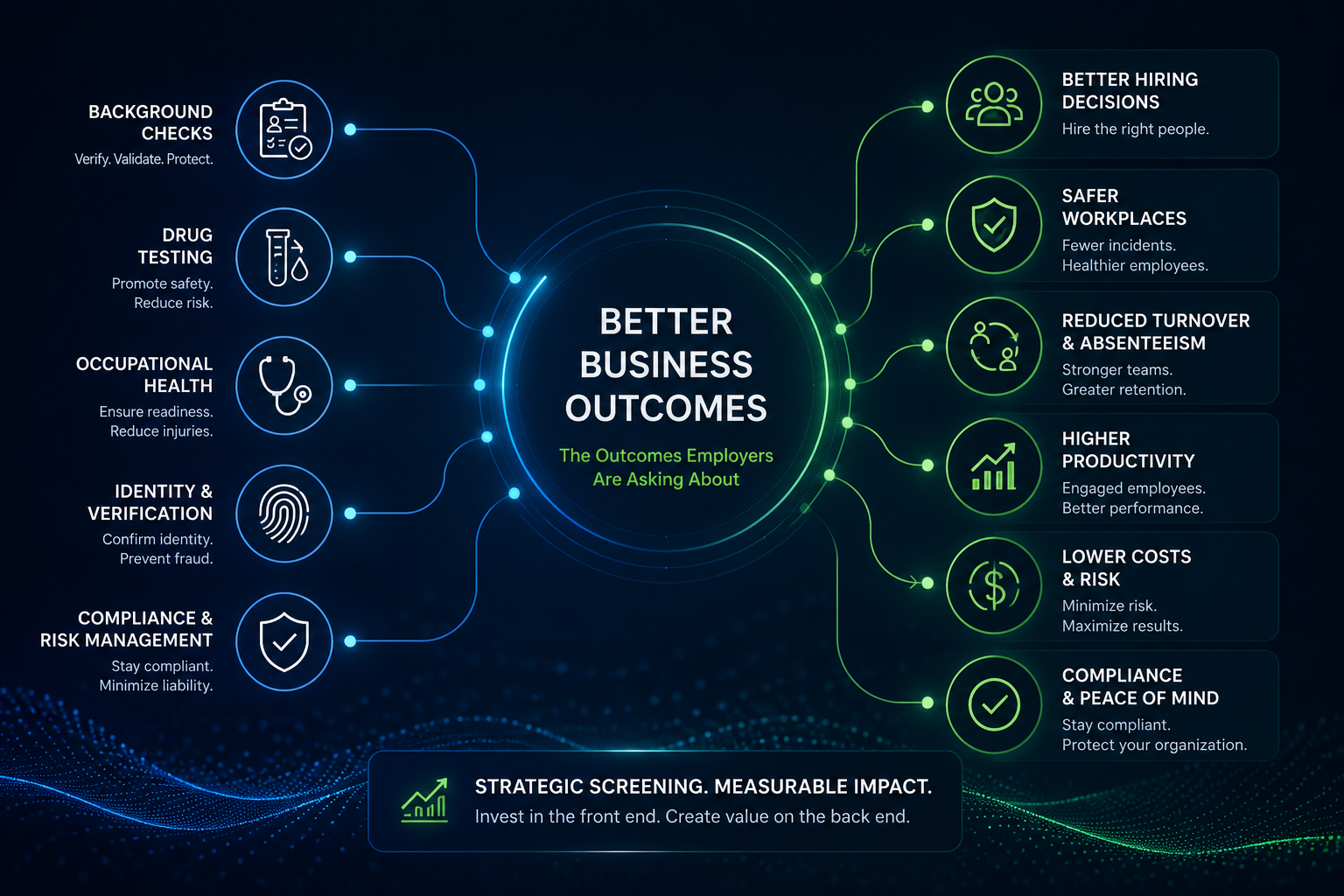
If you’re a CRA and you’re facilitating pre-employment drug testing, why stop there? Could you help employers manage a complete drug and alcohol testing program that includes random, post-accident and reasonable suspicion testing, along with return-to-duty and follow-up testing when applicable? Could occupational health services such as physicals, vaccinations, titers or other employment-related medical services solve additional problems for the same customer?
The same opportunity exists for TPAs. If you’re already managing drug and alcohol testing, perhaps background screening is a logical extension. If you serve transportation companies, Driver Qualification File management could solve another significant compliance and administrative challenge. Random program management, supervisor training, occupational health and other adjacent services may create similar opportunities.
This isn’t about building the longest possible menu of services. It’s about asking: What other problems do our customers have that we’re well positioned to solve?
Sometimes the best growth opportunity isn’t another customer. It’s becoming more valuable to the customers you already have. And the more meaningful problems you solve, the harder it becomes to reduce your value to the price of a single transaction.
Differentiate the Experience
If two providers send a specimen to the same laboratory and the donor visits the same collection site, the underlying transaction may be virtually identical. The experience surrounding that transaction doesn’t have to be.
How easy are you to work with? What does implementation look like? How quickly can someone get help? What happens when something goes wrong? Does the customer have to chase your team for answers, or are you identifying issues before they become the customer’s problem?
Every screening company says it provides great service. Simply saying it isn’t differentiation. The customer has to be able to experience the difference, and your salespeople need to be able to explain specifically what that difference means.
The same applies to customization. Standardization creates efficiency and scalability, but customers don’t necessarily want to feel standardized. That doesn’t mean custom-building everything. Thoughtful configuration of workflows, integrations, reporting, communications, implementation and service can make a largely standardized solution feel remarkably customized.
There is a big difference between saying, “Here’s how our system works,” and asking, “How does your business work, and how can we configure our solution to support it?”
Put Your Expertise and People on the Table
One of the most undervalued assets in the screening industry is experience.
Knowing how to order a DOT drug test is one thing. Understanding how to help an employer manage a compliant DOT drug and alcohol testing program is another. Offering occupational health services is one thing. Helping an employer determine which services belong in its program and how they should fit into the hiring process is another.
Your customers may encounter certain screening problems occasionally. Your team may have encountered those same situations hundreds of times. Education, consultation, best practices and even the willingness to challenge the way something has always been done all have value.
The people delivering that expertise matter, too. Technology matters tremendously, but as technology improves across the industry, technology alone becomes harder to use as a sustainable differentiator.
The person managing an implementation matters. The person answering a difficult support question matters. The person who recognizes an unusual compliance issue matters. The person who understands the customer’s business well enough to say, “There’s probably a better way to do this,” matters.
The best technology should make those people more valuable, not make them disappear. Automate repetitive work and eliminate unnecessary touches, then give good people more time to solve problems, share expertise and build relationships.
That’s much harder to put into a comparison spreadsheet, which is exactly the point.
Give Them Something Better to Compare
At i3screen, we work with CRAs, TPAs and other screening providers trying to grow their businesses and deliver more value to their employer clients. Our technology helps providers manage drug and alcohol testing and occupational health programs, connect with laboratories and clinic networks, integrate those services into existing screening workflows and expand the services they can offer.
But technology is only part of the equation. The bigger opportunity is using technology, expertise and relationships together to build a better screening business. That means thinking about implementation, automation, integrations, occupational health, program management and workflow design—not simply processing another transaction.
Price will always matter. Turnaround time will always matter. There is nothing wrong with talking about either one. The mistake is allowing those to become the only things a prospect knows how to compare.
When someone asks, “How much?” and “How fast?” early in the conversation, recognize what they may really be telling you: They don’t yet know enough to see the difference.
That’s your opportunity to lead. Ask better questions. Understand their business. Teach them something they didn’t know before the conversation started. Help them develop better criteria for evaluating their options.
But make sure your organization has done its part as well. Create services worth discussing. Create an experience worth differentiating. Develop expertise worth sharing. Give your people the ability to solve problems.
Then give your salespeople something worth selling.
If you don’t want customers to compare you on price and turnaround time alone, give them something better to compare.