We’ve Seen This Before: Why Occupational Health is the Next Frontier in Workforce Screening

Matt Wrobel Senior Business Development Manager i3screen
When I started thinking about what to propose as a presentation for this year’s PBSA Annual Conference, I kept coming back to something I’ve watched happen over the course of my career, and it is happening again.
If you have been in the screening industry long enough, you have seen this movie before.
Go back to the late 1990s and early 2000s. Background checks were growing, but they were far from universal. Drug testing was common in certain industries, but there were still plenty of employers that simply didn’t test.
Applicants knew it, too.
People with criminal histories knew which employers conducted background checks. Drug users knew which employers tested. And they adjusted their behavior accordingly.
Employers that screened weren’t simply identifying risk after someone applied. The existence of the screening program itself became a deterrent. Applicants who knew they were unlikely to pass often went somewhere else — frequently to employers with fewer screening requirements.
Over time, employers caught on.
Background checks and drug testing became understood not simply as hiring expenses, but as investments in risk reduction, safety, compliance, and workforce quality.
I believe we are watching something similar happen again. And that’s why I chose occupational health screening as my topic for PBSA this year.
Employers Are Asking a Different Question
For decades, much of employment screening has focused on a few fundamental questions:
Who is this person? What is in their background? Are they using prohibited drugs?
Those questions remain important. But employers are increasingly asking another:
How can we ensure this person is healthy enough to safely perform the job we are hiring them to do?
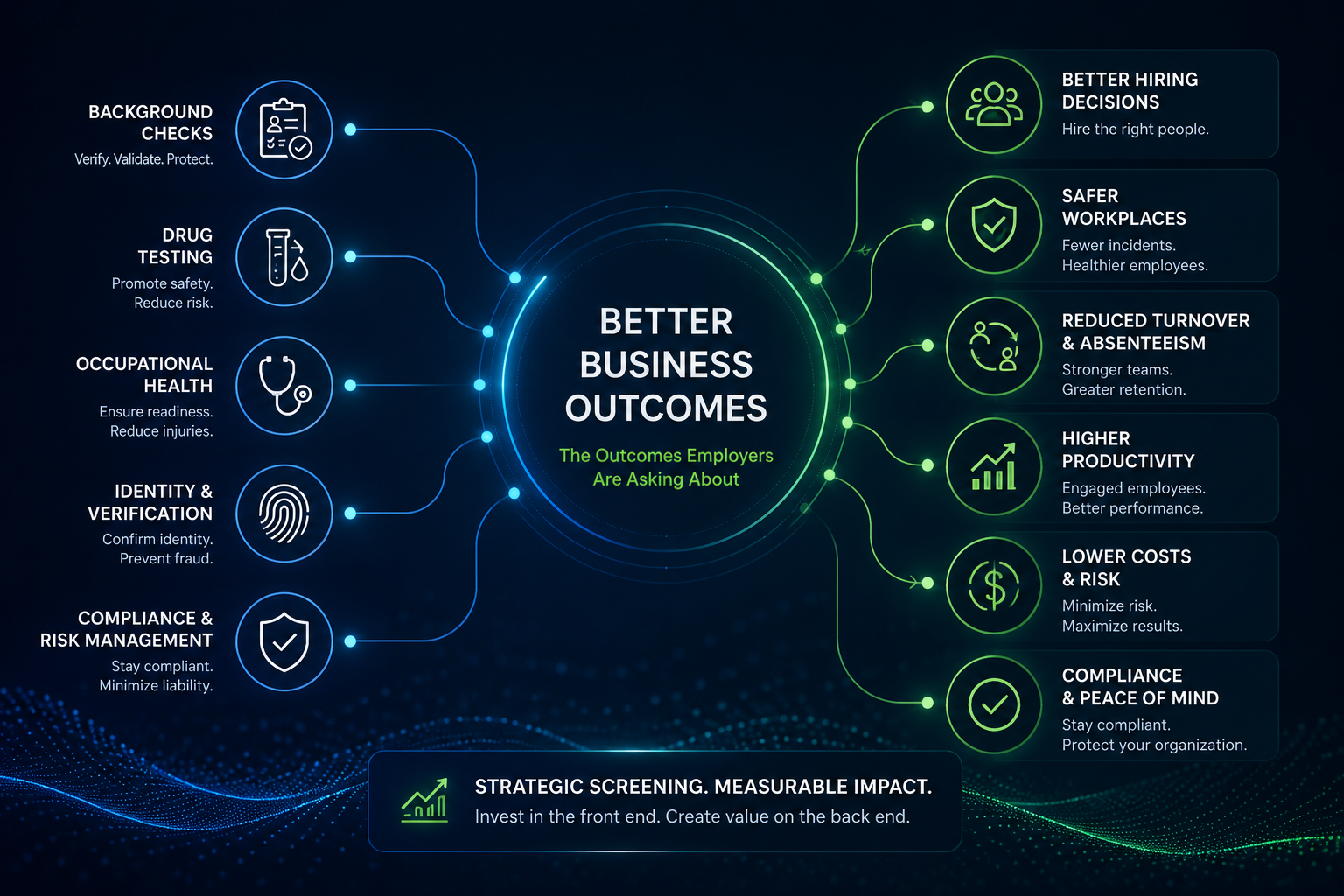
Depending on the position, answering that question may involve physical examinations, functional assessments, respirator clearance and fit testing, hearing and vision testing, vaccinations, TB testing, DOT physicals, or other job-specific requirements.
And employers are beginning to understand the economics.
Hiring and training are expensive. Workplace injuries, workers’ compensation claims, lost productivity, replacement workers, and operational disruption can be far more expensive.
For the right positions, investing on the front end to better understand workforce readiness can potentially prevent much larger costs on the back end.
Sound familiar?
It should.
CRAs Have a Choice
This is the conversation I most want to have at PBSA.
Occupational health screening is still relatively new as a broadly integrated component of employment screening. But employer interest is growing, and I don’t believe the opportunity will remain this wide open forever.
CRAs have a choice.
We can wait for clients to recognize the need, research their options, find a solution, and then ask whether we can support it.
Or we can educate ourselves now, identify where occupational health screening makes sense, and start the conversation with our clients.
One approach is reactive. The other is playing offense, and there is more at stake than just a new revenue stream.
Every additional workforce screening service a client obtains somewhere else creates another vendor relationship and another opportunity for someone else to become a strategic partner to that employer.
Why shouldn’t the CRA already trusted with background screening, drug testing, compliance, and hiring workflows be the one starting this conversation?
Learn From the Past to Predict the Future
None of this means CRAs should become healthcare providers. Understanding where occupational health coordination ends and clinical healthcare begins is critical — and it is one of the important boundaries I’ll address in September.
But we should understand what’s happening in the market well enough to talk intelligently with our clients about it.
Background checks evolved. Drug testing evolved, and employer expectations evolved with them.
I believe occupational health and workforce readiness represent another evolution — and CRAs have an opportunity to get on the front end of it.
That’s why I chose “Beyond the Background Check: The Next Frontier in Workforce Screening” as my topic for the 2026 PBSA Annual Conference.
If you’re attending PBSA, I hope you’ll join me in September. I want this to be more than a presentation; I want it to start a broader conversation about where our industry is going and the role CRAs can play in getting there.
And if you aren’t going to be there but this sounds like a conversation your organization should already be having, let’s have it.
Because sometimes the best way to see what’s coming next is to look at what we’ve already seen before.